Home > News & Stories > Meet the 2025 Fellows: Troy Osaki
News & Stories
Meet the 2025 Fellows: Troy Osaki
Published: July 31, 2025
Categories: Artist Interviews
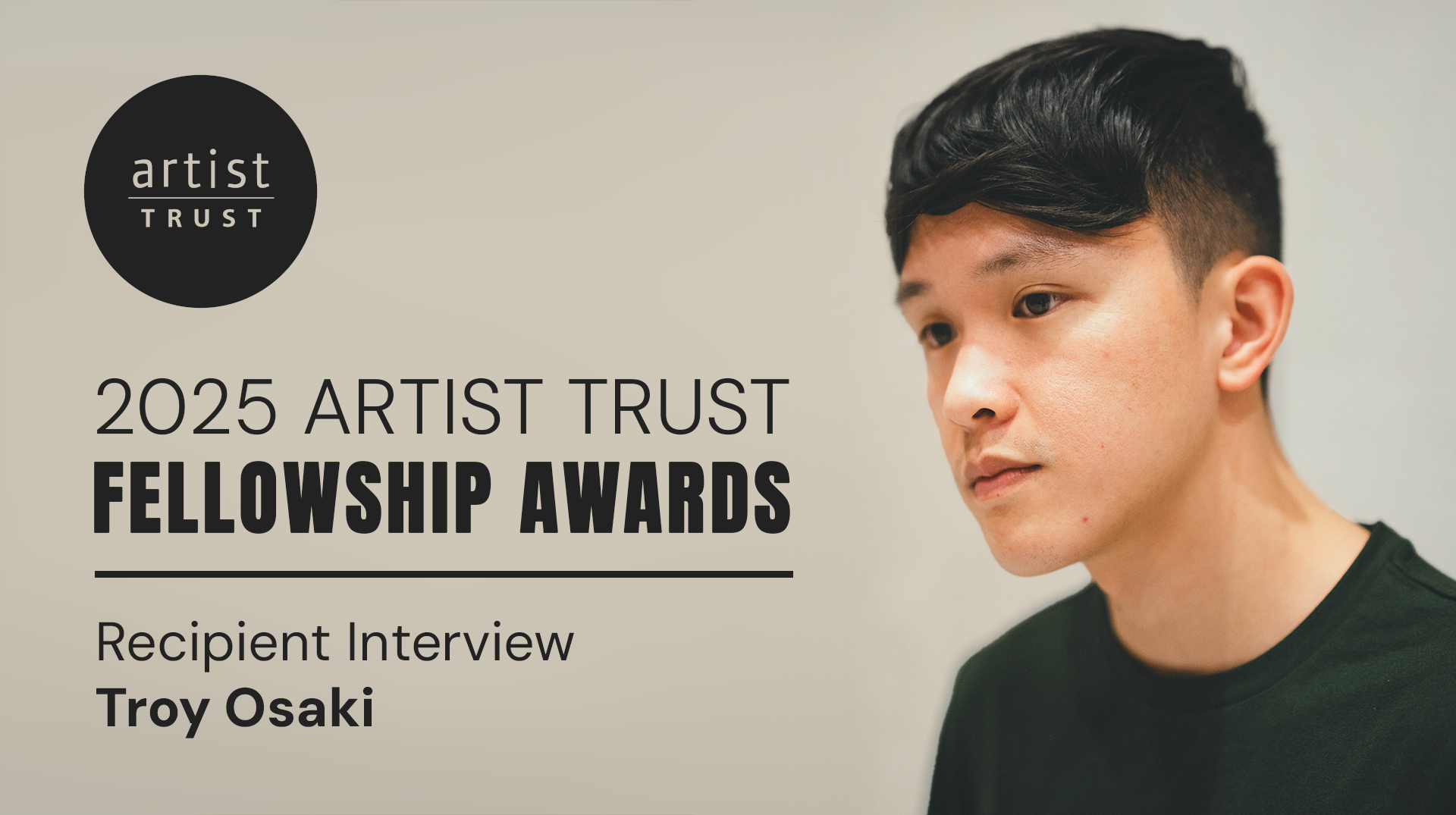
About Artist Trust Fellowships
Artist Trust Fellowships are merit-based awards of $10,000 providing unrestricted support to practicing professional artists of exceptional talent and ability residing in Washington State. The first Artist Trust Fellowship Awards were selected in 1987, making it our longest-running award program. In 2025, $150,000 was awarded to 15 artists across five Washington State counties.
Our Meet the Fellows series highlights each of the award winners over the year in a series of interviews and social media highlights. To support grants programs like the Artist Trust Fellowships, visit artisttrust.org/donate
Interview with 2025 Artist Trust Fellowship Recipient Troy Osaki
Please introduce yourself and share a little about yourself and your background.
I’m Seattle-born. I’ve driven Lake Washington Boulevard more times than I’ve said my name out loud. It’s my favorite road in the city.
When I was five, I saw Seattle SuperSonics starting Center, Patrick Ewing, in the parking lot of Tower Records on Mercer Street. I asked for an autograph, and he got in his car and drove off instead. I don’t hold it against him. I still want the Sonics to come back someday.
I attended Garfield High School, which is where my mom attended and my grandma, the Black Panther Party, Jimi Hendrix.
The smell of rainwater lives in my hair.
I say all this because I’m rooted in Seattle. My family left their home countries and landed here. They came during military occupation, or they were exploited on Hawaiian sugar plantations, or during the war, they were separated from one another and incarcerated.
All of this shapes who I am. All of this shapes why I write.
I’m Filipino Japanese. My family has been abroad for generations. We’ve lived in Seattle for half of it. I want my people to return home someday.
Your writing beautifully connects activism, familial memory, and personal experience. What is your process for beginning a poem, what inspires you to start?
I start with a moment. Something small and mundane, unimportant. I write into it and dig. I try not to overthink where to start or what it can be, to not outline the idea before I write it.
Here’s what I mean.
Last month, I visited my grandma in Beaverton. I took her to IHOP. She’s 94 years old and doesn’t talk much anymore, but it’s okay. I love most how she remembers my face. We sat at the table and said nothing. After 20 minutes, she reached toward the center, plucked three single-serve French Vanilla creamers from a small bowl, and stuffed them in her pocket.
There’s not much more to the moment than this, but I write it down. If I keep writing and digging, then I may discover something I didn’t know was there. Maybe it’s how her hair reminds me of good wind in a sandstorm. Maybe it’s noticing how she hums more than she talks, and maybe it’s because it helps her remember.
At a certain point, there’s a turn or a discovery. I dig deep enough and there’s a poem or, at the very least, the corner of one, a piece of it, enough to know where it wants me to go.
In sitting, quietly, with my grandma, the turning point may be realizing she doesn’t talk much in person, but I still hear from her through her writing. The mail she sent her dad while incarcerated in separate camps, her diary entries from Minidoka, then later on, her haikus. I return to them again and again.
I learn something new about her, about our family. I learn something new about wars of aggression. How U.S. imperialism connects my family’s separation to a thousand more families today.
This is when I start to see the light through the dirt. How my personal and family experience connects to the world around me. How all of this means something only if I’m willing to change it.
I dig and keep digging until I’m through.
Art is constantly changing and developing. How has your work developed over the last few years?
My recent obsession has been with the archive. Examining historical documents, creating found poetry. It’s been crossing the line from witness to persona.
I’ve been fortunate to inherit files my grandma and her siblings preserved from World War II. Letters my great grandparents wrote to each other and their kids while separated in camp, my great grandpa’s arrest record, applications for reuniting families, applications for repatriation, photos of boiler rooms and piles of coal.
I’ve chosen to step into these documents and write from the perspective of family members. I think of what each of them would say. What moments felt memorable enough to share, who in camp they’d want to remember in a story.
I’ve been writing these poems to give voice back to my family whose voices were locked away. Buried in sandstorms. Buried in barbed wire. Most importantly, I’ve been writing poems to not fixate on the past but to connect my family’s experience to what’s happening today. Detainment, imprisonment, deportation.
It’s not enough to examine our history. The point is to change its course.
What keeps your creative practice moving forward? Why do you create?
While in prison for his political beliefs, Turkish poet Nâzım Hikmet wrote,
It’s this way:
being captured is beside the point,
the point is not to surrender.
being captured is beside the point,
the point is not to surrender.
I care about writing because I care about my people, about those who are oppressed and exploited around the world. People of colonies and semi-colonies. People waging struggles for self-determination and national liberation. People of the working class.
I care about them winning the world over.
Poetry has a role in helping create change. It’s shaped people’s hearts and minds for centuries. I feel moved to write and contribute in the ways that brought me and so many others to take action beyond the page.
As a 2025 Fellowship Recipient, can you please talk about how this award has impacted you?
One of the first grants I received to support my poetry was an Artist Trust Grants for Artist Projects award in 2019. It set me on a path to step further into my craft. Over the years, I continued to receive support from Artist Trust through office hours, accessible workshops, and feedback from panelists of awards I didn’t receive. Becoming a 2025 Fellowship Recipient is a culmination of this endless support. It’s an affirmation of the work I’ve done to develop into the poet I am today, and reenergizes me to continue writing.
How can Artist Trust continue to support artists across Washington State?
When I received my first Artist Trust award, I didn’t have many poems published in journals or major awards on my resume. Today, I still have yet to publish my first full-length book of poems. Even so, Artist Trust values my work and believes in my potential. I’ve received ongoing support and feedback, and have been challenged to get better year after year.
As an emerging writer, I know how important this kind of support is to furthering my craft. My ask of Artist Trust is to continue working with emerging artists who may not be well established but are dedicated to their craft, show immense potential, and want to contribute to enlivening our arts community.
2025 Meet The FellowsArtist Trust Fellowship AwardsInterviewTroy Osaki
Related Stories
Support Artists
We work hard serving thousands of individual artists across Washington State each year, but we can’t do it without you! Learn how you can support artists year-round.
Image: Peggy Piacenza, 2024 Fellowship Recipient