Home > News & Stories > Meet the 2025 Fellows: Diamond Beverly-Porter
News & Stories
Meet the 2025 Fellows: Diamond Beverly-Porter
Published: September 3, 2025
Categories: Artist Interviews
About Artist Trust Fellowships
Artist Trust Fellowships are merit-based awards of $10,000 providing unrestricted support to practicing professional artists of exceptional talent and ability residing in Washington State. The first Artist Trust Fellowship Awards were selected in 1987, making it our longest-running award program. In 2025, $150,000 was awarded to 15 artists across five Washington State counties.
Our Meet the Fellows series highlights each of the award winners over the year in a series of interviews and social media highlights. To support grants programs like the Artist Trust Fellowships, visit artisttrust.org/donate
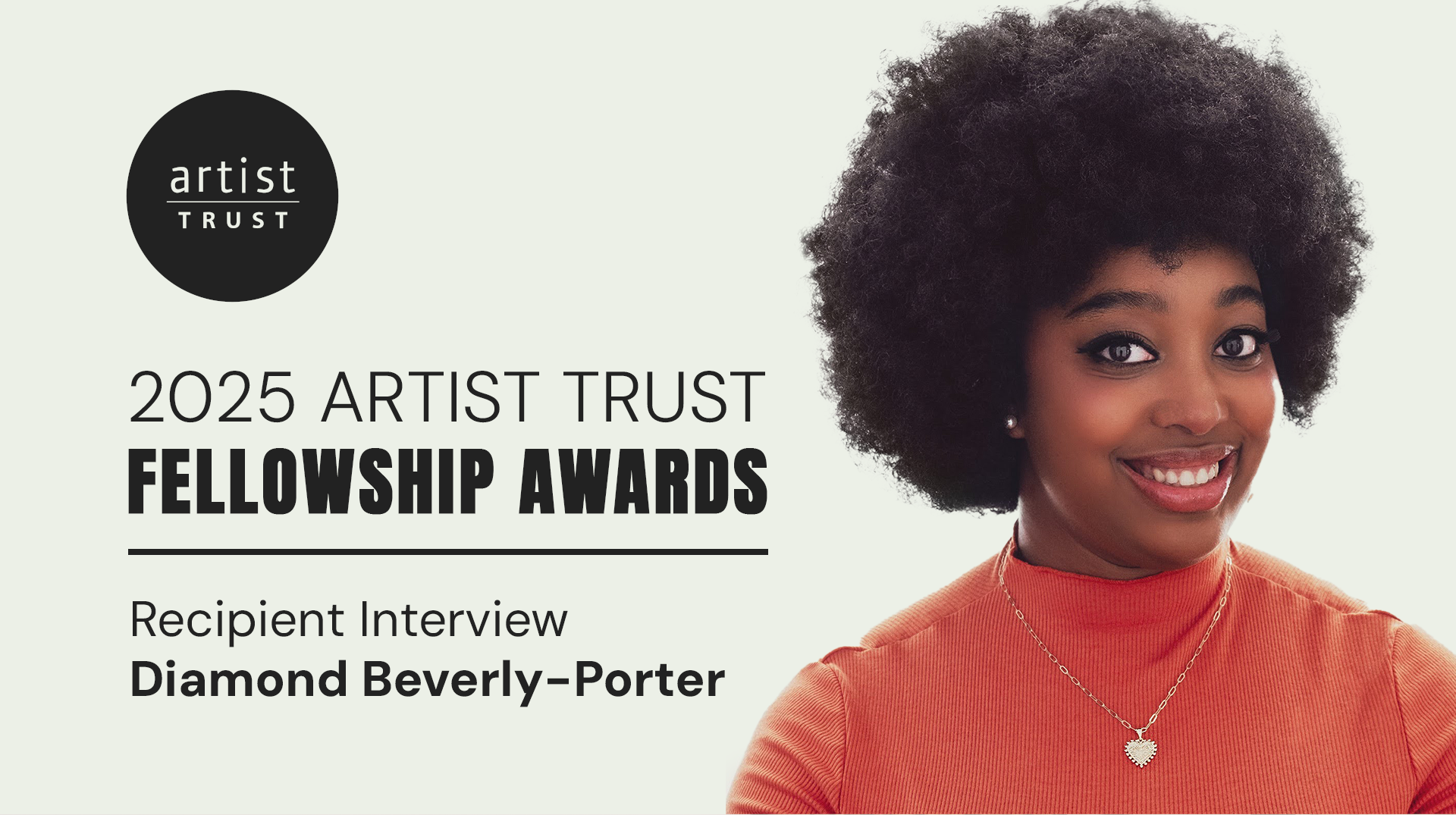
Interview with 2025 Artist Trust Fellowship Recipient Diamond Beverly-Porter
Please introduce yourself and share a little about yourself and your background.
My name is Diamond Beverly-Porter, and I’m an artist, video game designer, and tenure-track Assistant Professor in the Department of Digital Technology and Culture at Washington State University. My work sits at the intersection of play, storytelling, interactivity, and critical making, driven by a belief in the transformative power of digital art and games to elevate underrepresented voices—especially those of Black women and girls. I earned my B.S. from Tarleton State University and my MFA from the University of Texas at Dallas. Alongside my academic practice, I serve as the Research & Supportive Outreach Lead for The SmART Project, a South Dallas nonprofit dedicated to increasing arts access for youth.
At the core of my creative and scholarly practice is a deep interest in how culture, technology, and systems of power shape which stories are told—and how they’re told. I explore communication across mediums in ways that challenge dominant narratives, often remixing theory and lived experience to center marginalized communities. Drawing from Black cultural traditions, oral histories, and historical memory, I treat games not just as entertainment but as critical tools for storytelling, resistance, and reflection.
I view care—both collective and individual—as a radical act, essential to imagining liberation in the face of systemic oppression. My work is grounded in this ethos: to create spaces where Black players, especially young Black girls, can see themselves not as background characters or stereotypes, but as protagonists navigating worlds on their own terms. Through immersive technologies, digital storytelling, and intentional collaboration, I strive to build joyful, culturally resonant experiences that honor identity, community, and the power of play.
 Diamond Beverly-Porter, game still, Unreal Engine 5, 2025
 Diamond Beverly-Porter, game still, Twine, 2024
 Diamond Beverly-Porter, game still, Unreal Engine, 2022
In many of your games you powerfully confront socio-political topics and center Black American culture, both within and outside of the gaming world. What inspired you to use game design as a mode for talking about and bringing attention to these topics?
As a child, I longed to see myself reflected in the games I played. But positive, nuanced representations of Black people—especially Black girls—were nearly nonexistent. That absence profoundly shaped both my creative and academic pursuits. Game design became my way of reclaiming space and crafting the kinds of stories I needed growing up.
Rather than existing as isolated environments, virtual spaces carry the residue of our cultural histories and reproduce the logics of power that structure everyday life. Influenced by visionary creatives and scholars like Octavia Butler, Zora Neale Hurston, and Toni Morrison, I see game design as a speculative and theoretical practice. These thinkers have taught us how to remix past, present, and future—how to imagine otherwise.
In my own work, I explore Black American culture through an Afrofuturist and Black Feminist lens: one that reflects on the present moment while engaging with the echoes of the past and imaginative futures, all within contemporary technological frameworks. I see race, memory, and cultural expression as technologies in themselves—constructs that shape a living present. Games, for me, are both tools of critique and celebration. They challenge systems of exclusion while honoring Black culture, oral traditions, and the joy found in community.
Art is constantly changing and developing. How has your work developed over the last few years?
My work has expanded beyond critical making to examine how game media operates within culture. I explore questions of representation and player experience—who is centered in gameplay, who is pushed to the margins, and how Black fans interpret Black characters. I also consider how systemic oppression is reflected in virtual spaces and how fan labor, such as modding and fanfiction, becomes a means of reclaiming identity and visibility in games.
Over the past few years, my work has become increasingly immersive and collaborative. I’ve intentionally partnered with BIPOC creatives across disciplines to expand the possibilities of game design. By integrating oral histories, archival research, and custom game mechanics, my projects more deeply connect lived experience with digital representation.
 Diamond Beverly-Porter, card game, linen cardstock, 2024
 Diamond Beverly-Porter, game asset, Maya Autodesk, 2024
What keeps your creative practice moving forward? Why do you create?
I create the games I wanted as a young Black girl—worlds where I could see myself reflected—because I believe representation is not just visibility, but a form of liberation. My work is grounded in a deep commitment to cultural visibility, representation, and joy. I’m driven by the desire to honor my community’s stories and offer new imaginative possibilities for Black youth—particularly young Black girls who rarely see themselves reflected in digital media. What keeps me going is the community—family, friends, students, players, fellow artists—who connect with the work. Every time someone says, “I’ve never seen myself in a game,” it reaffirms why I do what I do.
As a 2025 Fellowship Recipient, can you please talk about how this award has impacted you?
Receiving the 2025 Fellowship is both an honor and a powerful affirmation of my work. It signals that there is space and value for Black-centered stories in the digital arts. This award allows me to continue developing Rhythm and Rope, a game that reimagines cultural memory through joy, Black American culture, and storytelling. As a part of a small percentage of Black game developers, this support is especially meaningful. It helps me connect with others doing similar work and opens doors for collaboration and visibility, ultimately contributing to a more inclusive and representative gaming landscape.
How can Artist Trust continue to support artists across Washington State?
Artist Trust can continue to support artists by expanding access to funding and resources, with particular attention to emerging and BIPOC artists in underrepresented and rural communities. This could include expanding outreach efforts, offering mentorship opportunities, and supporting projects that explore new approaches across disciplines. Creating additional pathways for community-based storytelling, artist-led workshops, and intergenerational collaboration would also be meaningful ways to foster inclusive artistic growth. Support for digital and interactive media artists—who often fall outside traditional categories—is also vital in this evolving creative landscape.
2025 Meet The FellowsArtist Trust Fellowship AwardsDiamond Beverly-porterInterview
Related Stories

Support Artists
We work hard serving thousands of individual artists across Washington State each year, but we can’t do it without you! Learn how you can support artists year-round.
Image: Peggy Piacenza, 2024 Fellowship Recipient