Home > News & Stories > Meet the 2025 Fellows: Mehrdad Gholami
News & Stories
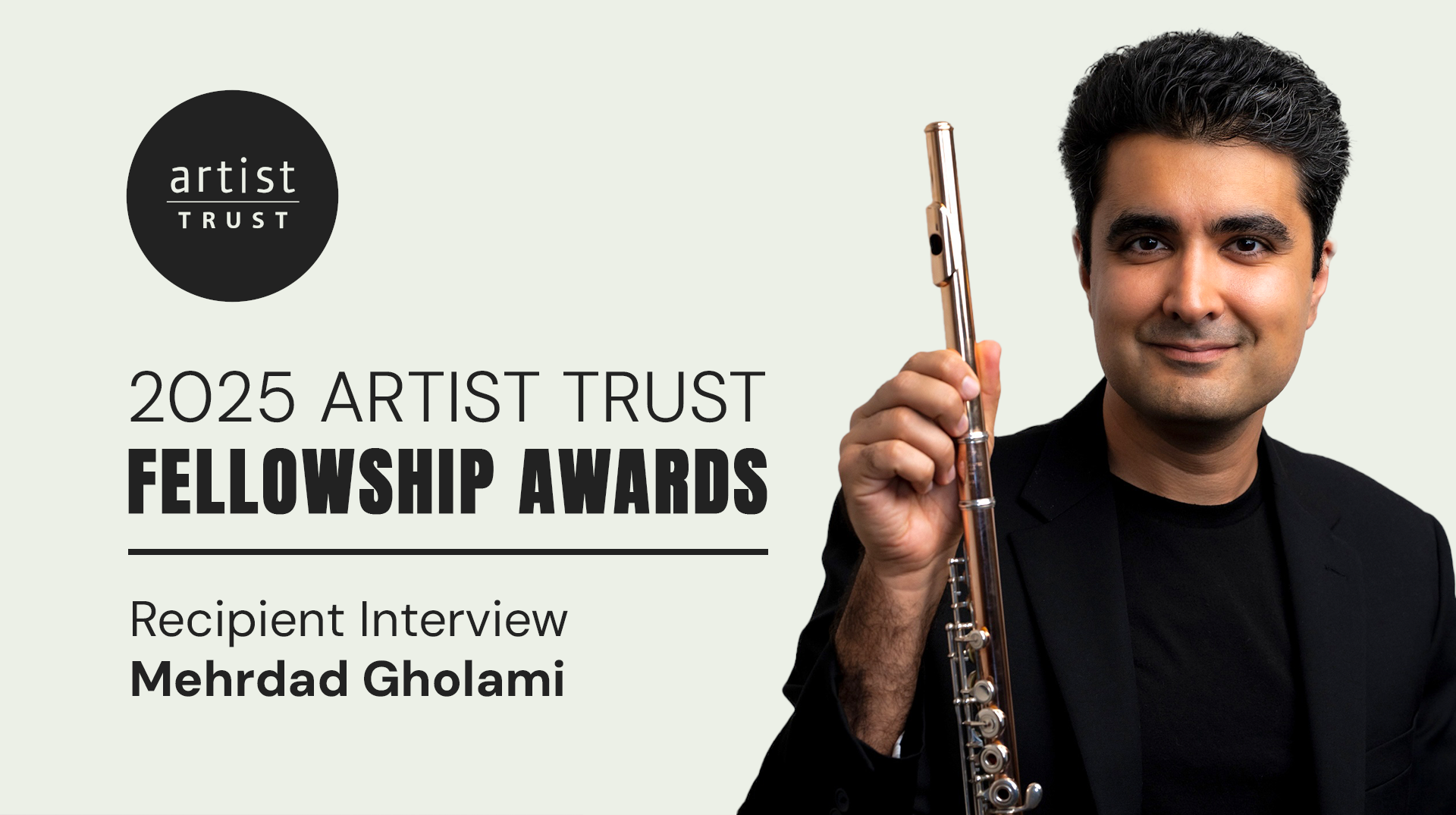
Meet the 2025 Fellows: Mehrdad Gholami
Published: September 23, 2025
Categories: Artist Interviews
About Artist Trust Fellowships
Artist Trust Fellowships are merit-based awards of $10,000 providing unrestricted support to practicing professional artists of exceptional talent and ability residing in Washington State. The first Artist Trust Fellowship Awards were selected in 1987, making it our longest-running award program. In 2025, $150,000 was awarded to 15 artists across five Washington State counties. Our Meet the Fellows series highlights each of the award winners over the year in a series of interviews and social media highlights. To support grants programs like the Artist Trust Fellowships, visit artisttrust.org/donateInterview with 2025 Artist Trust Fellowship Recipient Mehrdad Gholami
Please introduce yourself and share a little about yourself and your background.
My name is Mehrdad Gholami, and I am the Assistant Professor of flute at Western Washington University. I was born in Tehran, Iran, and I grew up in Tehran, where I attended the University of Tehran’s School of Fine Arts. After receiving my undergraduate degree in flute performance, I came to the States to continue my education and ultimately finish my doctoral degree in flute performance. After graduating, I continued teaching for a few years until two years ago my current job brought me to Washington State. Given the fact that my wife and I are very much into hiking and outdoor activities, I feel very privileged to be living in one of the most beautiful places in the United States.
Your current work focuses on researching, commissioning, recording, and publishing music of the Caspian Sea region, an area not well known or researched among contemporary music scholars. What has this process been like for you in connecting with and bringing awareness to contemporary musicians from this region?
Commissioning and performing new pieces by Iranian composers has always been the core and center of my career ever since I was a teenager back in Iran. When I was writing my doctoral dissertation, I realized that there was not a single English source that traced the history of Western music in Iran, so I wrote a long chapter on that which ended up winning the National Flute Association’s research competition. Throughout this journey, there have been so many pieces that I’ve come across from the broad Caspian Sea that I’ve eventually shifted my focus to have a broader lens to that whole region. I think the most important aspect of my work and my colleagues’ work has been focusing on the future and how can we contribute to the current canon of classical music. However, you want to define “classical” music. I recorded a solo album a few years ago that won the best album of the year in contemporary music back in Iran. My next project was writing a collection of folk songs for two flutes based on a version harmonized by an Iranian composer and currently, I am working to commission and record pieces for flute, violin piano, and flute and guitar.
 Mehrdad Gholami, Iran Flute Society album cover
 Mehrdad Gholami, The Vast Sky album cover
I think the most important shift in my career over the past years has been my new interest in writing about flute and education. As a university professor, and as an artist, I’m always curious to see how can I truly treat the education side of my career as an art and I’ve realized years and years of experience teaching a wide variety of students has immensely contributed to my own playing as well. In addition, I feel like after my 2022 solo album, I feel a little bit more comfortable, performing music that is not necessarily the cutting edge avant-garde sounding pieces. This comes from my own educational journey and the fact that the presence of pieces that were doable by an intermediate-level performer was very narrow. This really shifted my focus from plain pieces that I knew were almost impossible to pull off to pieces that I know will get performances for decades to come by many other people, especially, back in Iran.
What keeps your creative practice moving forward? Why do you create?
This is a really hard question to answer because if I want to be truthful, I should say I don’t know any other way to live. I’ve always felt like I am interested in so many subjects and I want to say what I think about those things and somehow music and flute have become the medium that I would want to communicate these ideas with. I have this notebook that I have carried with me for years and it might have around 40 to 50 ideas for future projects that I want to do. It keeps piling on and I keep adding to it. I love the fact that looking at that notebook and just simply flipping through the pages is my main source of creative fuel. To steal the idea from Milan Kundera, I guess we are all individuals who are grappling with immortality, or to be exact, lack of it.
As a 2025 Fellowship Recipient, can you please talk about how this award has impacted you?
As I was talking about my creative process, and I mentioned that notebook with all the ideas that I’ve collected over the years, I realized that the most important thing for me right now is to be able to create time. Realistically, when you are trying to also make a living as an artist, you will end up doing many extra projects on the side that although artistically they might be enriching, but every one of those extra projects is taking away from your core artistic mission. I would say the most important thing that the Fellowship gave me for this summer was time to sit down and write, get into the studio, and record. I’m getting in touch with the composers that I’ve been wanting to work with and discuss projects and make them happen. In addition, as I do my own recording, a portion of the project went to getting a couple of higher-quality microphones. On top of all of these, I will be using part of the fellowship to commission and generate a new cohort of pieces for flute, violin, and piano that goes with my broader project on the Caspian Sea.
How can Artist Trust continue to support artists across Washington State?
It’s really hard to fine-tune an organization that is already doing so much good for the arts community. I guess my take would be just continue doing what you have been doing over the years. I was looking at the yearly report that I received in the mail and the fact that Artist Trust has been able to tap into so many different pools and sections of society, from big tech to individual donations, and channel that into their mission, is extremely impressive. So, I have a big thank you to you and the whole team!
2025 Meet The FellowsArtist Trust Fellowship AwardsInterviewMehrdad Gholami
Related Stories
Support Artists
We work hard serving thousands of individual artists across Washington State each year, but we can’t do it without you! Learn how you can support artists year-round.
Image: Peggy Piacenza, 2024 Fellowship Recipient