Home > News & Stories > Meet the 2026 Fellows: Dan Hurwitz
News & Stories
Meet the 2026 Fellows: Dan Hurwitz
Published: August 13, 2026
Categories: Artist Interviews
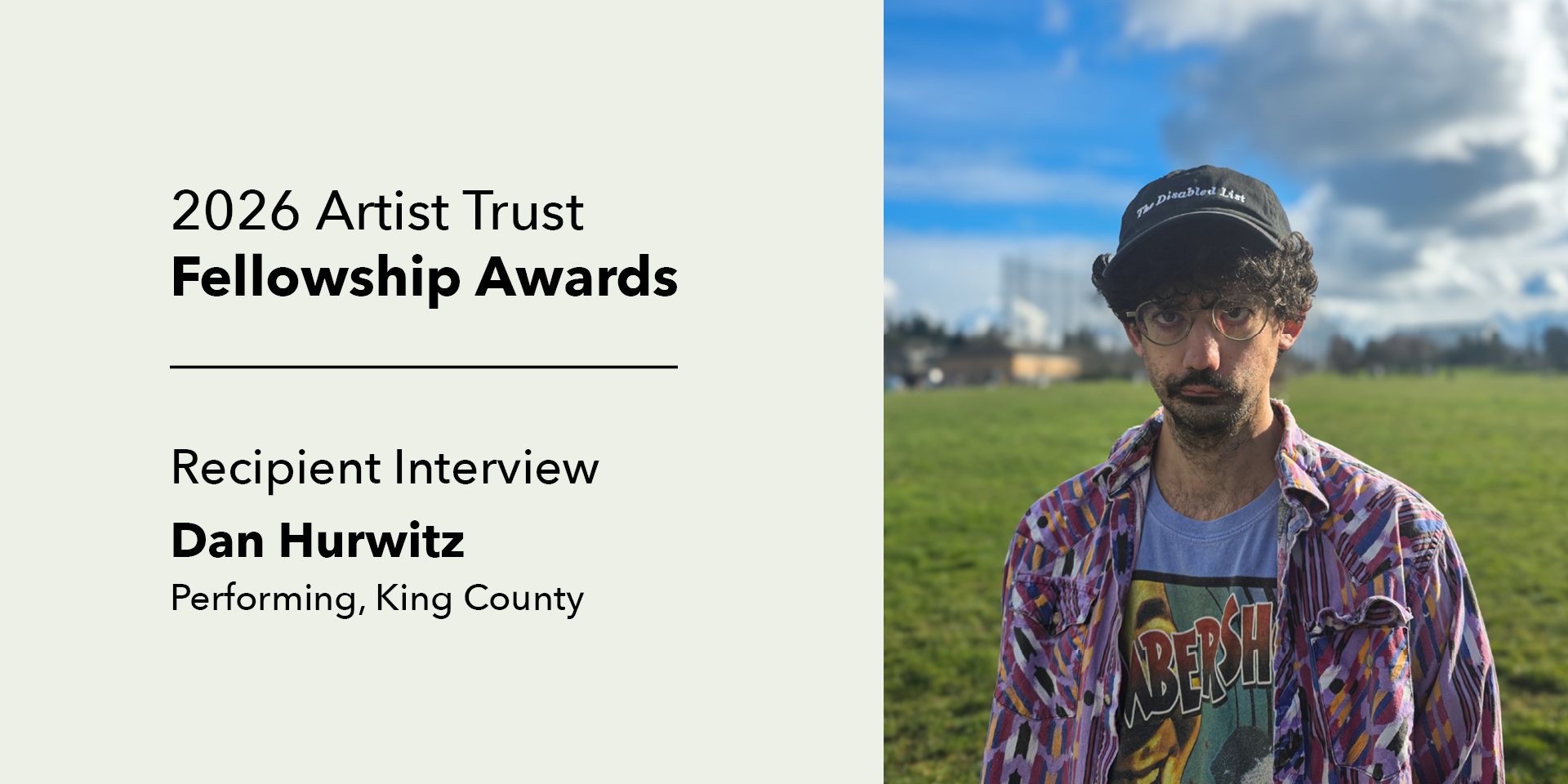
About Artist Trust Fellowships
Artist Trust Fellowships are merit-based awards of $10,000 providing unrestricted support to practicing professional artists of exceptional talent and ability residing in Washington State. The first Artist Trust Fellowship Awards were selected in 1987, making it our longest-running award program. In 2026, $160,000 was awarded to 16 artists across five Washington State counties.
Our Meet the Fellows series highlights each of the award winners in a series of interviews and social media highlights. To support grants programs like the Artist Trust Fellowships, visit artisttrust.org/donate
Interview with 2026 Fellowship Award Recipient Dan Hurwitz
Please introduce yourself and share a little about yourself, your background, and what draws you to your work as a performing artist.
I’m from the east coast originally. I’m the middle of three children, which probably explains a lot about my need for validation and attention. I feel like my upbringing was fairly typical, insofar as any Black-Jewish family can be fairly typical. Lots of laughter, lots of arguing, lots of fighting with my younger brother. Humor was a constant, although more I think as a way to survive a chaotic household than as an artistic pursuit. My parents raised us on Mel Brooks, and I picked up The Simpsons and Weird Al Yankovic from my older brother.
I moved to Seattle in 2007, and started comedy in 2017. There’s an immediacy and intimacy to comedy that I love. Comedy allows you to translate your experience so that someone who is completely different from you can understand it. Of course, comedy is not the only medium that can do that—but you try playing the guitar with two fingers!
Comedy has allowed me to be in community with people in a way I never anticipated. I’ve been part of the Seattle stand-up scene for 9 years, but I’ve also been part of the disabled comedy community (and broader disabled arts community), as well. I’ve also been embraced by my local Beacon Hill community in a way that has been incredibly meaningful (I do a regular hyper-local parody news segment called “The Beacon Hill News” at Joketellers Union at The Clockout Lounge).
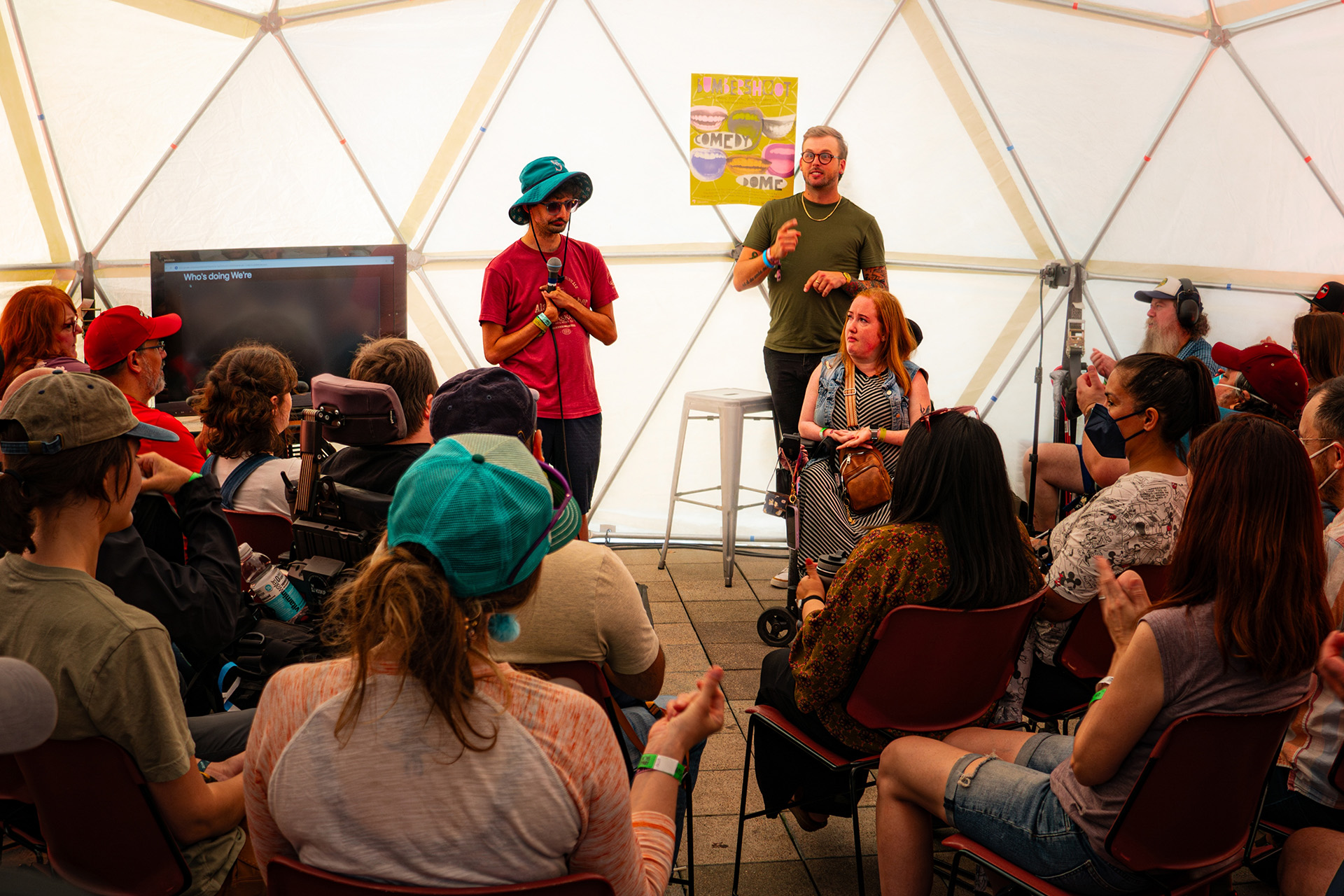 The Disabled List, Bumbershoot Comedy Dome Performance, 2024, Photo: Murphy Gilson
Your humor often draws directly from your own identity and upbringing, offering a type of intimacy that invites audiences to look directly at their own multitudes. How do you approach putting together your comedic sets when putting on shows for audiences of varying backgrounds?
My comedy flows from a belief—perhaps misplaced—in the universality of the human experience. So even though the particulars of my life are certainly different from the particulars of someone else’s, I think a lot of the underlying themes—embarassment, say, or disappointment, or feeling out of place—are things that most people can relate to.
I don’t necessarily try to change my material too much to what I think will suit a specific audience. I may make changes in the margins, but I think the power of any art is that the artist is inviting the audience to step into their world—to see things differently. As an artist, your job is to make that world true and believable. And particularly as someone with identities that are underrepresented, I always try to give an authentic view of my world, and of me.
On top of the aforementioned, there is a more pragmatic reason I don’t drastically change my approach based on the audience: writing jokes is hard, and I—like my comedy ancestors before me—am not a particularly hard worker. It takes a lot of work to write, test, and refine material. So if Aunt Susie doesn’t like my observations about what it’s like for disabled people to go through TSA—she better learn to like them.
Art is constantly changing and developing. How has your work developed over the last few years?
Technology has really changed things so much for comedians. I imagine this is true in every medium. We live in a world where someone can write, shoot and edit a movie with nothing but a cellular phone. It’s incredible, but it also brings with it expectations that as an artist you’re always producing content: creating reels, posting stand-up clips, being your own hype person online.
During the pandemic, my Disabled List co-producer Kayla Brown and I made a short film about a group of comedians trying to put on a comedy show during the pandemic (yes, it was meta). The film premiered at Northwest Film Forum’s Local Sightings Film Festival, and got accepted to some other festivals around the state.
I also began producing a web series about my journey to become the oldest half-Black, half-Jewish, disabled person to run the Philadelphia Marathon. The first season (consisting of one episode) is on TikTok and the second season is in pre-production (at the time of this interview in April).
Technology has really given us so many more ways to tell stories. I think the downside is sometimes it can feel like we’re devoting all our time to figure out how to trick the algorithms—rather than doing what we love. George Carlin never had to worry about meticulously curating his Instagram grid, and I’m sure he lived a happier life for it.
What keeps your creative practice moving forward? Why do you create?
This is my ninth year performing stand-up, and I think my reasons for doing it have definitely changed over the years. When I started, I think I was propelled by a belief—naive in hindsight—that stand-up was something I’d be good at. I call myself naive because I definitely had no clue, as a fresh-faced 33-year old, what the business of comedy entails, or how much work it takes to become a “successful” comedian. But it was a pretty simple notion at the time: I’m funny. I should try stand-up.
What I didn’t expect was to find so much community and purpose in comedy. Through making friends in the scene, and then starting The Disabled List, I really came to see that comedy—and I know there’s no way to say this without sounding obnoxiously self-important—can make a difference; it can be a force for good.
So I definitely see myself as having a different purpose now—in that now I do feel a sense of purpose and before I didn’t. The Disabled List has connected us in community to comedians and performers from across the U.S. and Canada, and it’s been incredible to see the positive responses from people—disabled and non-disabled—who come to our shows.
I’m grateful to have a reason to do comedy that is larger than myself; it’s sort of a counterweight to some of the less virtuous reasons I might want to be on stage—ego, self-importance, contempt for the five-fingered community. But my original reason for wanting to do comedy still stands—that is, wanting to laugh, and wanting to make others laugh. We live in a dark world. And to paraphrase Leonard Nimoy at the end of the Monorail episode of The SImpsons, “the world needs laughter.”
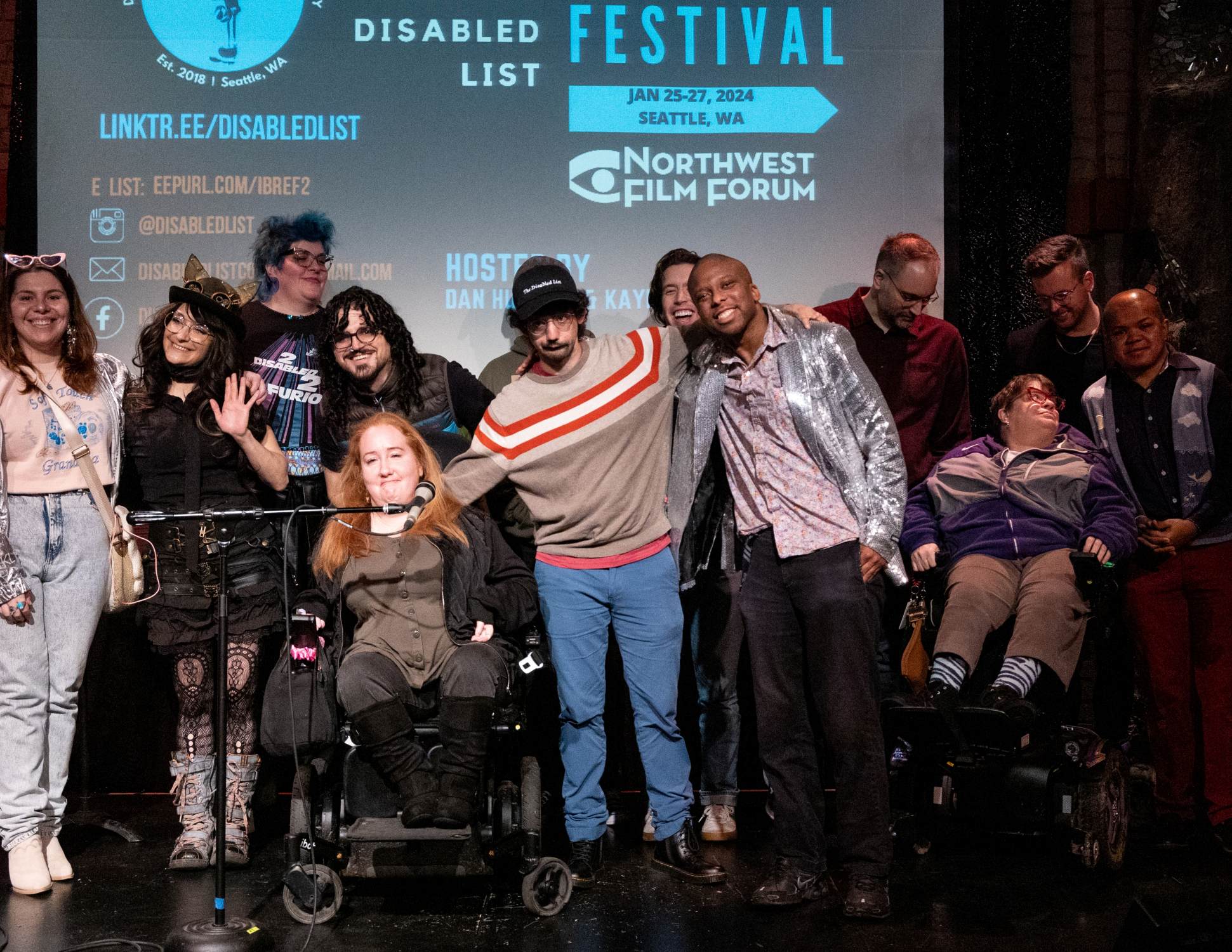 The Disabled List, Comedy Festival Group Photo, 2022, Photo: Maria Shamfarova
As a 2026 Fellowship Award Recipient, how has this award impacted you?
I’m incredibly honored to be a recipient for this award. As I said above, I came into the comedy world with pretty modest aspirations, and little idea about what my comedy future had in store. So to be recognized among so many incredible artists is truly amazing, and it speaks to what our community has been able to do, more so than it speaks to anything special about me. Like anything, comedy has its ups and downs, and this award helps validate that yes, the work that we have been doing is connecting and resonating with folks.
As far as the financial impact—ask me in a few months. I’d really like to use the award to take a big swing artistically: shooting a part two for our short film (it ended on the cliffhanger that was our at-the-time indefinite lockdown), shooting a comedy special, doing more short-form sketches. I’d like to use the award for something that would’ve been a stretch (or impossible) to do before the award, to swing for the fences, so to speak.
How can Artist Trust continue to support artists across Washington State?
Being in comedy, which is maybe not what you’d call a prestige medium, I think it’s easy to miss out on grant opportunities by assuming that they’re meant for someone else. I hope Artist Trust can continue to reach people across the entire arts landscape—and particularly those from communities that are underrepresented.
2026 Meet The FellowsArtist Trust Fellowship AwardsDan HurwitzInterview
Related Stories
Support Artists
We work hard serving thousands of individual artists across Washington State each year, but we can’t do it without you! Learn how you can support artists year-round.
Image: Peggy Piacenza, 2024 Fellowship Recipient